
Vari-Mu Compressor / Limiter
VariOhmAnalog glue. Musical control.
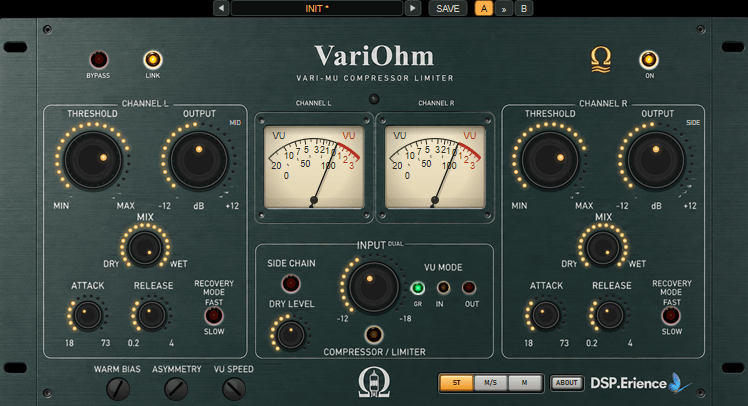
Push-pull 6BA6 cell
Remote-cutoff pentodes in triode connection, fitted to the datasheet, with a saturating output transformer and a vacuum-rectifier sidechain.
True VU metering
0 VU sits at −9 dBFS, switchable between gain reduction, input and output — with a VU SPEED control for when the needle is too slow for drums.
Stereo, Mid/Side or Mono
Real routing with an external side-chain input, and parallel compression per channel.
In detail
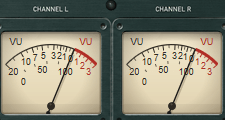
One true VU needle per channel
0 VU sits at −9 dBFS. Switch what they read — gain reduction, input or output — and speed them up to 4× when the standard 300 ms ballistics are too slow for drums.
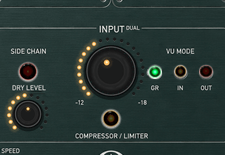
Drive, side chain and the ceiling
INPUT sets how much tube you hear (DUAL mark at +6 dB), DRY LEVEL handles the parallel path on its own, and COMPRESSOR / LIMITER moves the side-chain gain from leaning on the signal to holding the ceiling.
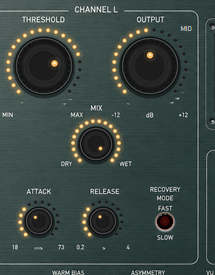
Independent channel
Threshold, Output, Mix, Attack, Release and Recovery Mode per channel. LINK makes the left lead and the right follow; unlinking keeps the mirrored value, with no jump.
VariOhm is a vari-mu compressor / limiter: the gain is not computed by a formula, it is the behaviour of a tube whose own operating point moves with the signal. The push-pull cell is built from 6BA6 remote-cutoff pentodes, triode-connected and fitted to the datasheet, feeding a transformer that saturates on the peaks, with a vacuum-rectifier sidechain closing the loop from the output. The circuit is solved sample by sample, so the compression, the harmonics and the way the unit recovers all come from the same place.
INPUT decides how much tube you are hearing and THRESHOLD decides how much it compresses — they are not interchangeable. The same 3 dB of gain reduction sounds one way reached with a lot of input and a high threshold, and another way reached with little input and a low one. Find the colour first with INPUT, set the amount with THRESHOLD, then bring the level back with OUTPUT.
ST / M·S / M is real routing, not a label: in Mid/Side the left channel works on the Mid and the right one on the Side, so you can hold the centre down while the sides breathe. MIX blends dry and wet per channel and DRY LEVEL sets the level of that dry path on its own, so the transients of the source survive while the tube works underneath.
Controls
- Threshold — where compression starts — MIN = more, MAX = none at 0 dBFS
- Input — −12 to +18 dB — how hard the tube is driven (DUAL mark = +6 dB)
- Attack — 18 ms (fast) to 73 ms (slow), measured on the circuit
- Release — 0.2 s to 4 s, default 0.6 s
- Recovery Mode — FAST single slope, or SLOW dual network: fast peak plus a programme-dependent tail
- Compressor / Limiter — side-chain gain: from leaning on the signal to holding the ceiling
- Warm Bias — idle bias of the tube — harmonic character before any compression happens
- Asymmetry — unbalances the two grids, bringing in the mostly even harmonics of the vari-mu colour
- Mix / Dry Level — dry-wet per channel, plus the dry path level on its own (±12 dB)
- VU Mode / VU Speed — GR, input or output · 1× (300 ms standard) to 4× (≈75 ms, reads like a PPM)
- Side Chain — feeds the detector from the external key bus
- ST / M·S / M — Stereo, Mid/Side or Mono routing
Specifications
- VST3, 64-bit — Windows 10 / 11
- Push-pull cell of triode-connected 6BA6 remote-cutoff pentodes, solved sample by sample
- Saturating output transformer · vacuum-rectifier sidechain in feedback
- Stereo, with external side-chain input
- Channel modes: Stereo, Mid / Side, Mono
- Attack 18–73 ms · Release 0.2–4 s
- Input −12 to +18 dB · Output ±12 dB · Dry level ±12 dB
- Metering: VU (0 VU = −9 dBFS), switchable GR / IN / OUT
- No external runtime required